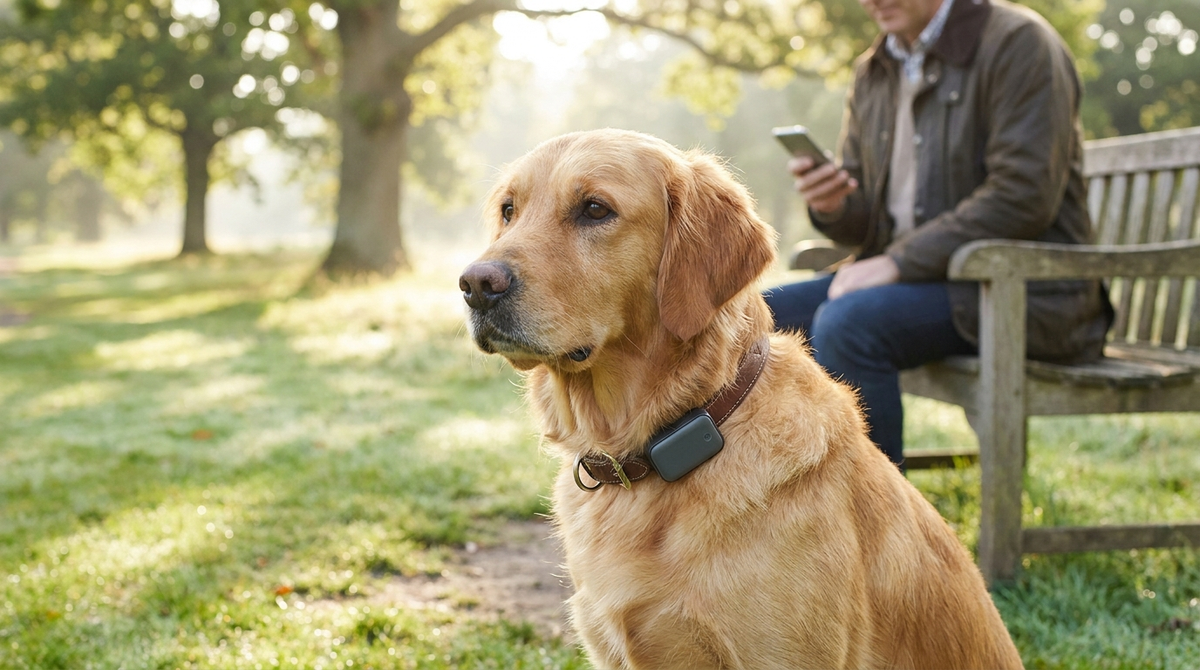
Every year, thousands of pets go missing in the UK. A microchip helps a found pet get identified, but it can't tell you where your pet actually is. That's the gap a GPS tracker fills: live location, on your phone, whenever you need it. But is one worth it for your pet? Here's an honest look.
How pet GPS trackers actually work
A GPS tracker attaches to your pet's collar and uses satellite positioning to work out where they are, then sends that location to an app on your phone. Unlike a Bluetooth tag (which only works within roughly 30 metres of your phone), a proper GPS tracker works at any distance — across the park, across town, or across the country.
Most trackers also offer extras like:
- Safe zones — get an alert the moment your pet leaves the garden
- Location history — see where your cat actually goes all night
- Activity monitoring — a rough picture of how much exercise your pet is getting
A tracker is not a replacement for microchipping
Quick but important note: in England, microchipping is a legal requirement for dogs and, since June 2024, for cats too. A GPS tracker doesn't replace the chip — it complements it. The chip proves who your pet belongs to once someone finds them; the tracker means you can do the finding yourself, in minutes rather than days.
Who genuinely benefits from one
A tracker earns its keep fastest if any of these sound familiar:
- Cats that roam. Outdoor cats regularly patrol territories far bigger than owners expect. If your cat has ever stayed out overnight and had you pacing the kitchen, a tracker turns panic into a map pin.
- Dogs with selective hearing. Spaniels on a scent, sighthounds on a squirrel — some dogs simply vanish on off-lead walks. A tracker won't improve recall, but it removes the worst-case scenario.
- Escape artists. Fence jumpers, gate limbo experts and dig-under-the-hedge specialists.
- Newly adopted or rescue pets who haven't bonded to home yet — the highest-risk period for going missing is the first few months.
- Nervous dogs around fireworks season. More UK dogs bolt around 5 November and New Year than any other time of year.
If your pet is an indoor cat or a velcro dog that never leaves your side, you can probably skip one — and that's fine.
What to look for when choosing
- Live tracking, not just periodic updates. When your dog is running, a location from four minutes ago isn't much use.
- Battery life of at least a few days between charges — a tracker that's always on the charger protects nobody.
- Size and weight appropriate to your pet. Cats and small dogs need a genuinely light unit.
- Water resistance — UK weather, muddy ditches, dramatic puddle sits.
- Collar attachment that actually holds. The best tracker in the world is useless in the long grass where it fell off.
So, is it worth it?
Think of it this way: the cost of a tracker is roughly what you'd spend on a couple of bags of decent dog food. Losing a pet costs days of searching, printed posters, sleepless nights — and sometimes far worse. For roaming cats, adventurous dogs and recent rescues, we think it's one of the highest-value pieces of kit you can buy.
Our GPS Pet Tracker with real-time location tracking works for both dogs and cats, with live tracking and safe-zone alerts through the companion app.
One last tip
Whatever tracker you choose, set it up before you need it. Charge it, fit it, create your safe zones, and do a test walk so you know how the app behaves. The worst time to learn a tracker's quirks is the moment your pet disappears over the horizon.